The executive summary is concise, confident, and easy to share. It says students find registration confusing and recommends simpler instructions. Before the team acts, someone asks what part of registration the finding describes.
A useful summary should help them find an answer. Its value includes the ability to look behind the headline, understand the support, and see where the interpretation stops. This matters whether a person or AI prepared the report. Clear writing should make the evidence easier to use, while keeping enough context to question the conclusion.
A finding should open a path to its support
Imagine a hypothetical study of adult students choosing a registration route. Some accounts describe uncertainty about which option applies to them. Other participants explain that the route was straightforward after an adviser helped them interpret the labels.
The headline “Registration is confusing” misses both the specific point and the difference in context. A more useful finding would describe uncertainty about selecting a route among the participants who encountered that issue. It could also note the role of prior explanation in the contrasting accounts.
The GOV.UK guidance on research analysis distinguishes what was observed from the finding the team draws from it. For a report reader, that distinction creates a useful expectation: they should be able to understand how the interpretation relates to the supporting material.
They don't necessarily need every raw response in the same place. They do need a suitable way to review the support when a consequential question arises. The arrangement should fit the research and the permissions around the material.
Show enough context to follow the reasoning
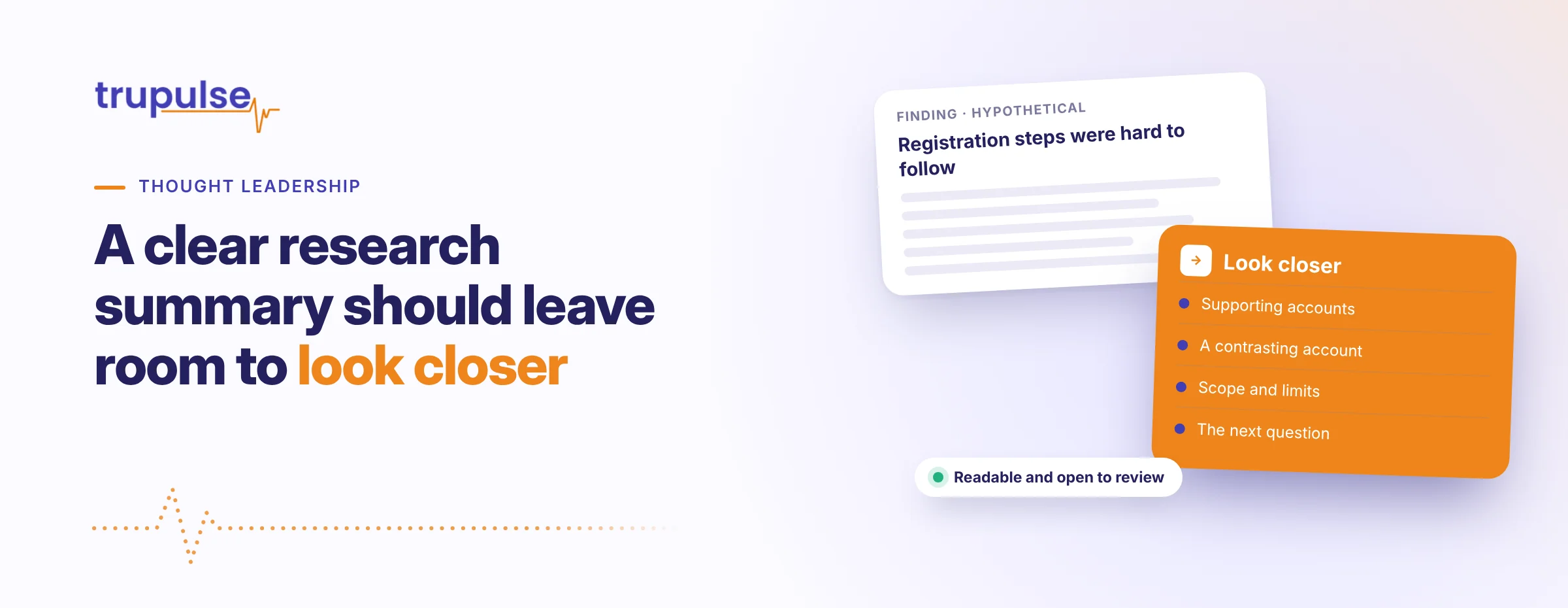
Think of the finding as a short card rather than a slogan. It would state the experience, describe the relevant support, include contrasting evidence, identify the scope, and leave a focused question for what comes next.
For the hypothetical registration study, the support could describe the accounts concerning route labels, with an appropriately sanitized illustrative quote if available. The contrasting material could explain how prior advising helped other participants. The scope would identify the people and service moment actually studied.
The limitation might be that the exercise didn't establish how common the experience is across all adult students. The next question could ask whether a revised explanation makes the route choices clearer to relevant users. Each part adds something the headline alone can't carry.
A quote makes an experience concrete, but doesn't measure its prevalence. Likewise, several similar accounts can support an interpretation without proving that a proposed wording change will solve the problem. The card keeps the learning and the proposed response related without merging them.
Make review proportionate and protect the people behind it
There is a fair concern that this approach could overload every report. Leaders need summaries because they have limited time. Requiring a long appendix for every sentence could make the document harder to use.
The answer is to give the central findings a proportionate review path. Keep the main account readable and make the support available in an appropriate form to the people authorized to review it. A consequential conclusion may deserve more scrutiny than a modest suggestion to explore a label.
Privacy is part of that design. GOV.UK's guidance on sharing research distinguishes removing direct identifiers from fully anonymizing an extract. Use the organization's established arrangements for redaction and access, and share only what is appropriate for the purpose.
Inspectable evidence doesn't mean unrestricted access. It means a reviewer can understand why a finding was made and, where needed, examine suitable supporting material without breaking the terms under which people participated. The review route may involve an analyst rather than a public link.
Give confidence a sound basis
AI-prepared summaries can help a team reach the discussion sooner when the underlying capability supports that work. The polished result still needs to be read as an interpretation of particular material. Presentation quality is a reason to engage with a report, not proof that every conclusion is sound.
A leader who asks for support isn't undermining the research. They are doing the work of deciding how to use it. A report that welcomes that question can be both concise and candid about uncertainty.
For your next findings review, choose one central conclusion and ask, “What could I inspect to understand why this was written?” Look for the support, the contrasting account, and the scope. That is a useful way to move from a convincing sentence to a considered decision.