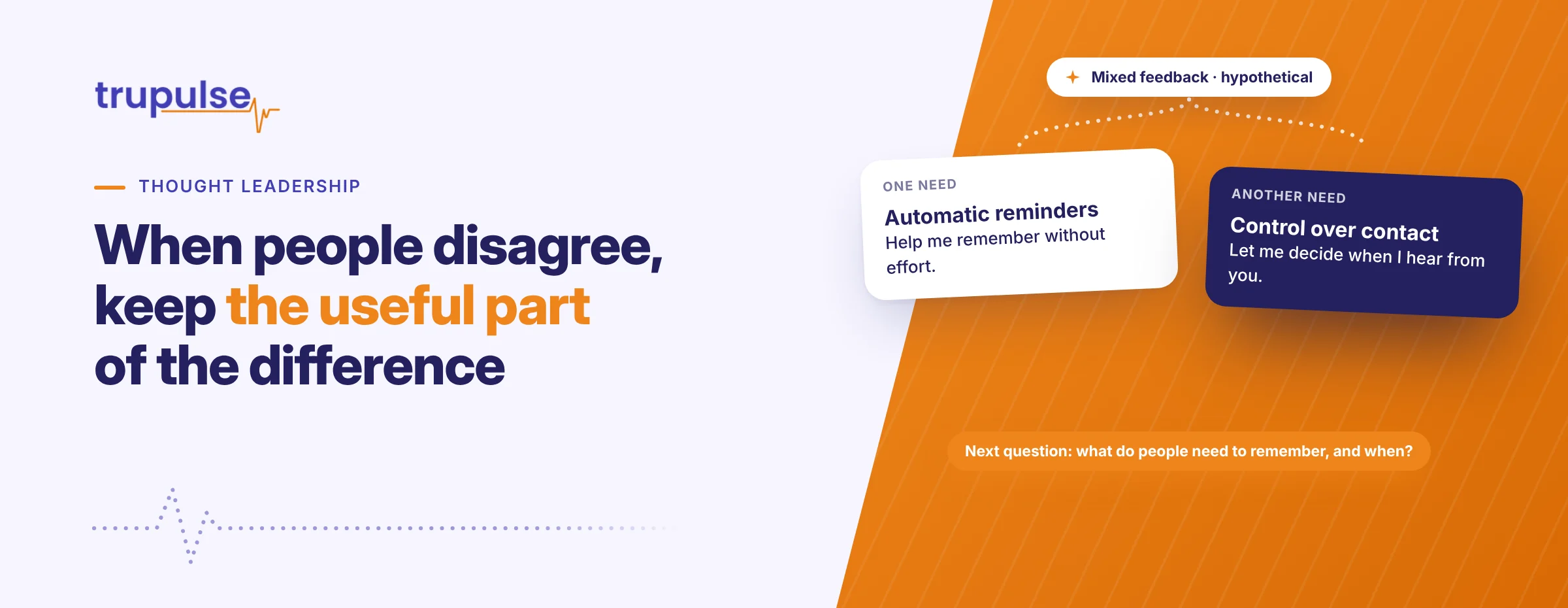
A group discusses a new service idea, and the responses pull in opposite directions. One participant wants automatic appointment reminders. Another wants to choose whether messages arrive at all. The summary could reduce the conversation to “mixed feedback” and move on.
That would leave the most useful question unexplored: what does each person need from the experience? Disagreement can help a team understand a choice more clearly. The aim is to preserve the reason for the difference long enough to learn from it, then make a decision that acknowledges the tradeoff.
Look for the need inside the position
Imagine a hypothetical discussion about reminders for a community service. A participant who welcomes automatic messages explains that appointments are easy to lose track of among other commitments. Another says that unsolicited messages feel intrusive and prefers deciding when to receive them.
At first, these sound like competing votes on a feature. Look closer and the design question becomes more interesting: how could the service support remembering while giving people understandable control over contact?
That reframing doesn't mean the group has agreed on a solution. It identifies two needs to explore. The team might investigate how people understand a choice at booking, what they expect it to mean, and which routes fit different circumstances.
The CDC's qualitative research guidance discusses how probing disagreement in focus groups can deepen understanding. The point is the explanation that becomes visible through the discussion, rather than treating the group as a simple preference count.
Preserve the reasoning, including its limits
A useful account keeps the positions connected to what participants described. In this example, remembering and control are interpretations of the hypothetical discussion. They deserve supporting material and a check that the summary represents the accounts fairly.
Also keep the unanswered questions. Did the person object to any reminder, the default setting, or a particular message channel? Did the person who wanted reminders know another option existed? A broad label such as “pro-reminder” can hide details that would change the design choice.
Silence doesn't settle the matter. People who didn't speak may have agreed, disagreed, or had something else in mind. If the study didn't establish a count or a population estimate, don't turn the summary into a majority claim.
Nor does every difference deserve the same weight. A concern tied to a clear experience may support a different next step from a speculative suggestion. The team should explain why an issue matters, considering the evidence and the consequences, rather than awarding equal priority to every statement.
Leaders still need to choose
Preserving every difference can leave a report indecisive. At some point, the team needs to decide what to build or change. Research can't become an endless catalog of reasons to postpone the choice.
But a clear tradeoff can help a decision. A leader who understands the need for both remembering and control can compare options against those needs. That is more useful than being told merely that some participants liked an idea and others didn't.
The final choice may favor one route, offer an appropriate option, or prompt a focused test before rollout. It won't necessarily satisfy every preference. The team can still explain what it considered and why the next step fits the service's purpose.
A good summary can therefore be concise and retain disagreement. “Participants described different expectations for default reminders, raising questions about remembering appointments and choosing contact” gives the next meeting a substantive issue to discuss. It doesn't manufacture agreement.
Make the difference worth keeping
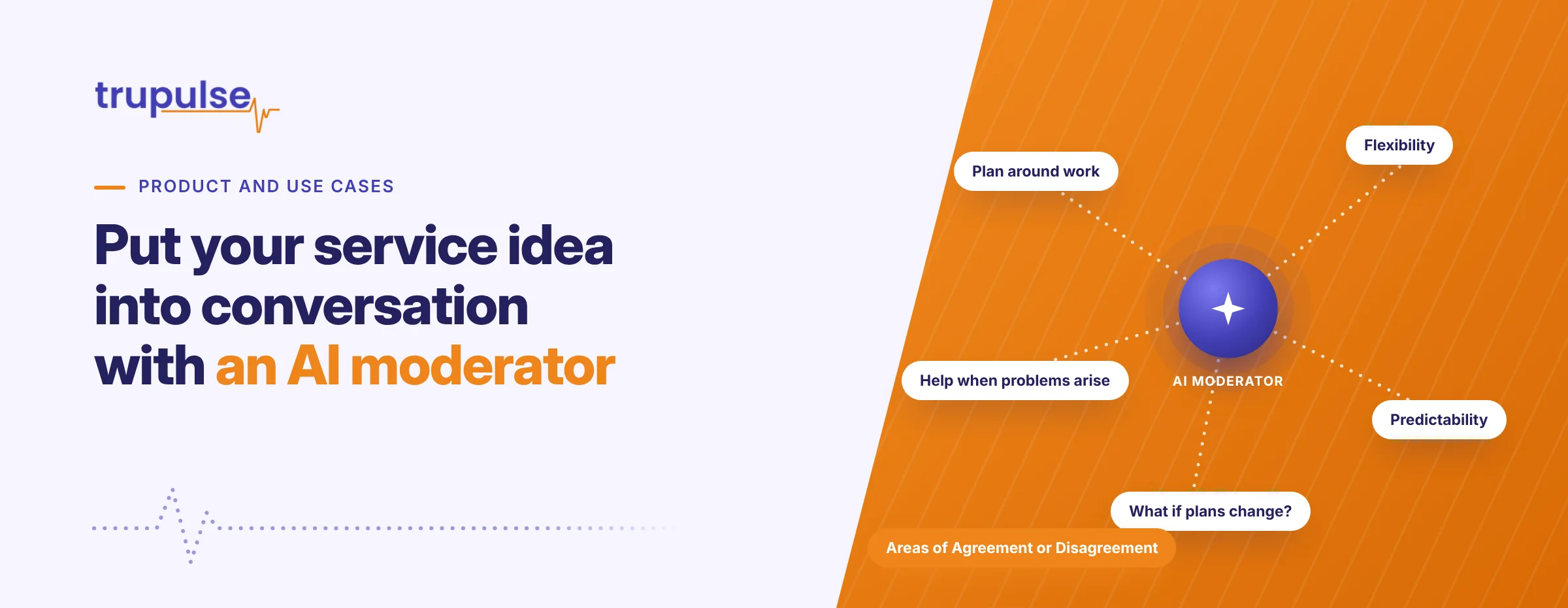
TruPulse Focus Group reports include Areas of Agreement or Disagreement alongside topic summaries and illustrative quotes. That gives the team a place to consider contrasting accounts as part of reviewing the results, rather than expecting a single uniform reaction.
What matters next is the interpretation. Ask whether the difference concerns goals, circumstances, understanding, or a choice the service needs to make. Then choose a question that would help distinguish those possibilities. Another study is useful when it has that clear job.
When your next report says “mixed feedback,” pause on one example. What did the contrasting accounts reveal that a single average or consensus sentence would lose? Keep that insight in the discussion. It may be the part that makes the eventual decision more thoughtful.