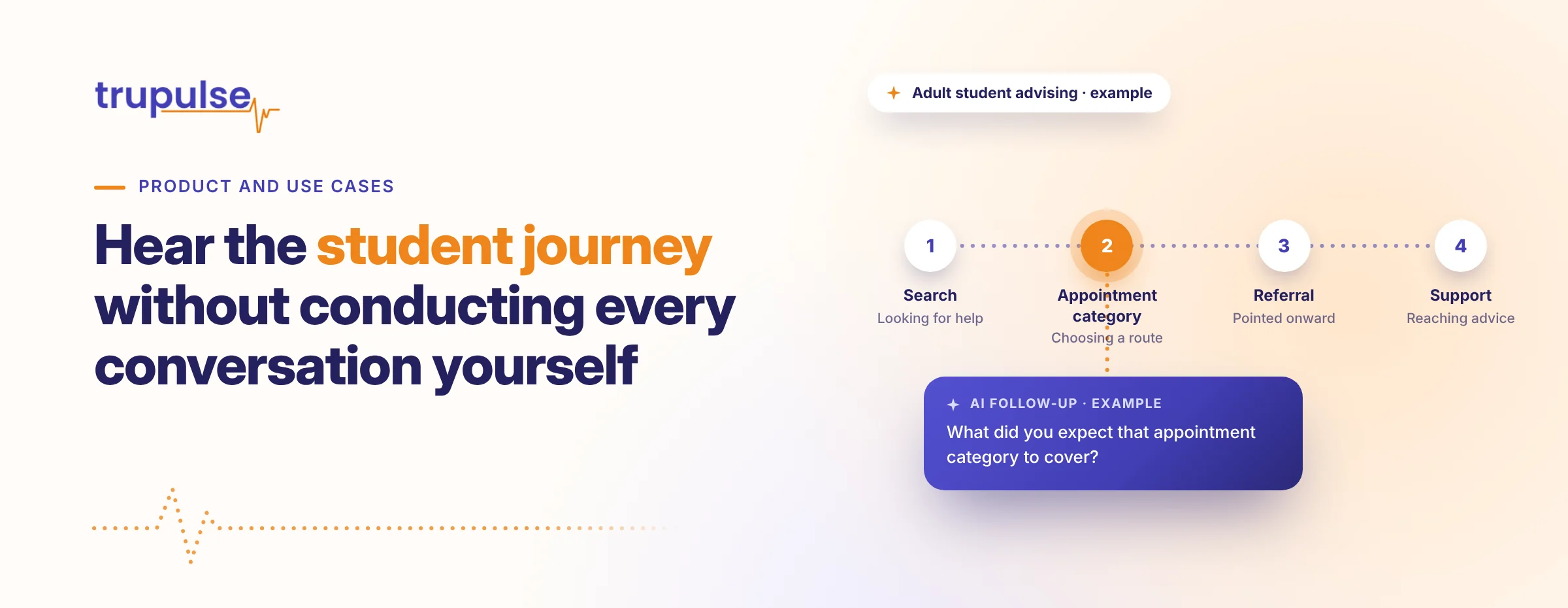
An adult student opens the advising page after work. They want a clear answer before choosing their next course, but the appointment options, instructions, and office hours leave them unsure where to begin.
Your college may know how many appointments were booked. Hearing the student's account can help you understand what happened before that booking, including whether they found another route or stopped looking. A focused set of questions gives your team a way to explore the service experience without asking students to explain their whole educational journey.
Start with one service moment
Imagine a college reviewing how adult students find and use an advising appointment. Keep the study centered on that journey: recognizing a need, finding information, arranging contact, attending if they do, and knowing what happens next.
That boundary keeps the conversation useful. You're learning how the service fits into someone's circumstances, including work schedules, caring responsibilities, or preferred ways to get help when those are relevant to their account. You aren't asking an advising study to predict academic success.
The GOV.UK interview guide encourages asking about particular experiences rather than general views of how things should work. Here, “Tell me about the last time you tried to contact advising” gives the student a place to start.
Use questions that follow the journey
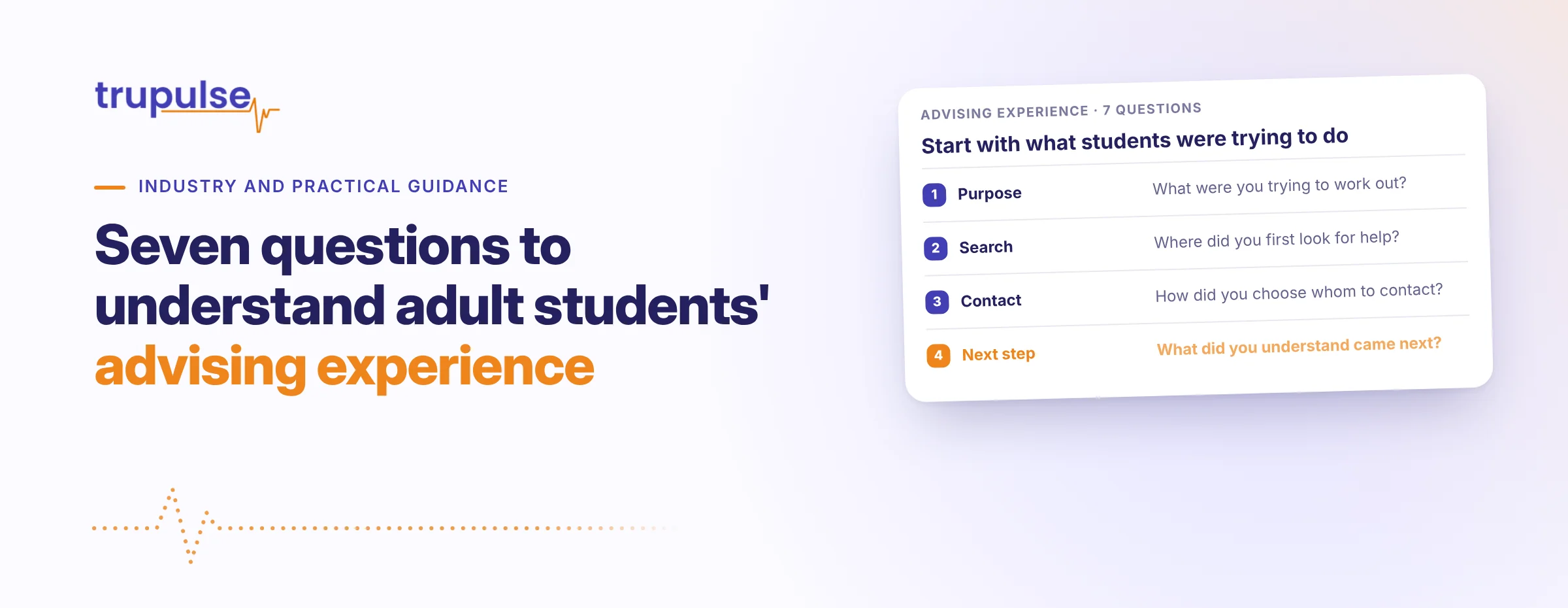
These seven original questions can form a short discussion guide for adult students. Adapt the terms to the service students actually encounter, and allow someone to skip a question or explain that it doesn't apply.
- What were you trying to work out when you last looked for advising support? Begin with their purpose, which may differ from the task your team expected.
- Where did you first look for information or help? This can reveal the starting point, including a person or an offline route.
- How did you work out whom to contact or which appointment to choose? Explore the information they used, rather than testing whether they knew the official process.
- What happened when you tried to arrange that contact? Invite a sequence of events, including anything that went smoothly.
- How did the available options fit around the other things you needed to do? Let the student identify relevant circumstances without requiring sensitive personal details.
- After the contact, or after deciding not to continue, what did you understand your next step to be? Include people who didn't reach an appointment.
- What, if anything, would have made the experience easier to navigate? This invites suggestions without assuming which solution is best.
A follow-up such as “What were you expecting at that point?” can clarify a gap. If a student says they couldn't find an appointment, ask what happened before suggesting that office hours were the cause. Different accounts may point to different improvements.
Hear from students at different points
Include people who completed an appointment, people who tried but didn't reach one, and people who sought another route. Where relevant, consider different study schedules and participation needs. Don't rely only on students already attending advising; the earlier steps are part of the service too.
Keep the invitation separate from any expectation to use the service. Explain the purpose, the format, how responses will be used, and who can access them under your institution's arrangements. Explain how taking part relates to access to advising and academic decisions, using the institution's actual arrangements.
The GOV.UK consent guidance offers a useful planning principle: participants should understand what taking part involves and how their information will be used. Your college's appropriate reviewers should determine the arrangements for its own context.
Turn a service story into something to explore
Suppose participants describe uncertainty about which appointment category to select. That suggests a specific place to investigate: the category names and explanations. Ask relevant students to interpret a revised version before assuming a redesign has resolved the issue.
Keep contrasting experiences in the report. Some students may find the categories obvious because an adviser explained them previously. Others may reach the page without that context. The difference helps you consider who needs the explanation and where it should appear.
TruPulse's AI-led 1:1 discussions and reports can support this kind of service exploration. Reports include topic summaries, illustrative quotes, Key Insights, and Next Steps, giving the team material to review alongside its understanding of advising operations.
Pick one recent service moment and adapt the seven questions around it. The goal is a clearer picture of what students encounter and a more informed choice about what to investigate next.