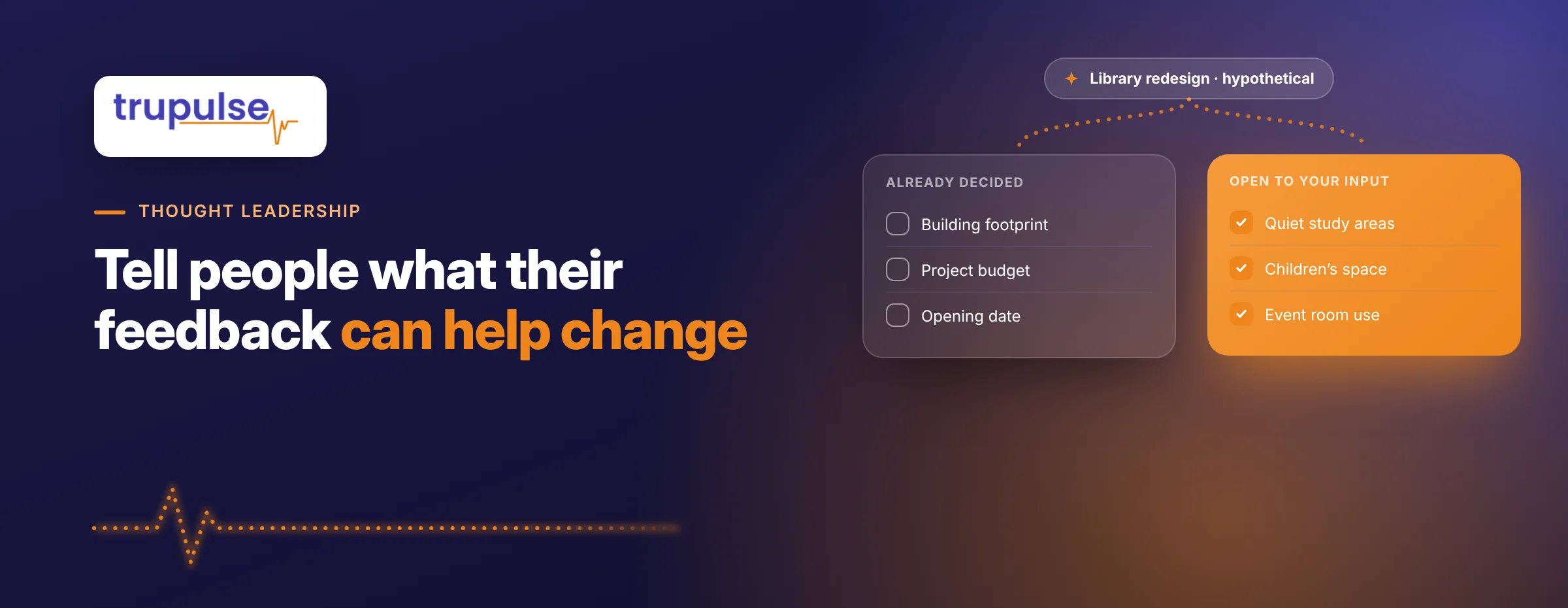
A library invites residents to comment on a service redesign. People offer ideas about a different location, new opening hours, and how to arrange appointments. Only afterward do they learn that the location had already been settled.
The remaining choices may still be important. The invitation would have been more useful if it had made them clear. Listening works better as an organizational commitment when the sponsor can explain what the learning may influence. That includes being open about fixed constraints and honest about what remains to be discovered.
A boundary can make the question more meaningful
Imagine a hypothetical library service moving into an approved space. The team can still explore appointment arrangements, signs, and information about getting help. It can't use this particular exercise to reopen the building choice.
A broad invitation to “shape the future of the service” could suggest more influence than the study offers. A clearer purpose would explain that the team wants to understand how people could find and use the service in the new setting, including what would help them navigate it.
This gives participants a real question to answer. Someone can describe a difficult journey or an access concern without assuming the study is a vote on the move. The team can hear problems with the setting while remaining clear about the authority of this exercise.
Being precise also helps the sponsor. It connects the learning to decisions someone can consider and keeps the team from collecting expectations it has no plan to address.
Define the room for learning
A useful scope note starts with the open question: what do we need to understand about using the new service? It records the fixed constraint, the evidence that would inform the remaining choices, and the person who can decide what happens next.
Then it describes the response the team can actually commit to. That might be reviewing the findings at a planned meeting and communicating the next step through a specific route. It shouldn't become a promise to implement every suggestion or give participants decision rights the exercise doesn't provide.
The GOV.UK guidance on informed consent includes explaining the purpose of research and how its results will be used. For a constrained service decision, those two points belong together. People should understand the question they are helping the organization explore.
This isn't a script for avoiding unwelcome feedback. A fixed decision can still have consequences worth understanding. If participants describe a serious difficulty the team hadn't considered, the sponsor should consider what further review is warranted through the appropriate route.
Exploration has a place before the decision is known
Organizations don't always know what listening will change. Sometimes the point is to discover needs or problems that haven't yet been named. Requiring a predetermined action could narrow the research too early.
That is a good reason to distinguish purposes. Exploration can aim to understand an experience and identify questions for further work. Consultation can seek input on choices the organization is considering. Evaluation can examine what happened after an approach was introduced. Explain the role of the exercise without implying that any of these automatically grants a shared decision.
An exploratory invitation can therefore be honest and open: the team is learning about experiences to help decide what deserves attention. It doesn't have to name a solution in advance. It does need someone willing to consider the learning and explain what follows.
The distinction is between an open outcome and an absent purpose. A team can welcome unexpected findings while still being clear about why it is asking, how it will review the answers, and where responsibility sits.
Carry the purpose through to the response
After the hypothetical library study, the team could explain which experiences it heard, which service choices it considered, and what it plans to investigate next. It could also explain why a suggestion falls outside the current project's scope and whether there is another suitable route for it.
That response needn't claim agreement from everyone who participated. Nor does the exercise establish a community mandate. Its value lies in bringing relevant experiences into a decision process the organization can describe.
The same principle applies to employee, customer, and member listening. People can contribute to a useful inquiry without being promised control over the final choice. Clear boundaries leave more room for an honest relationship between the invitation and the outcome.
Before inviting your next group, finish this sentence: “What we learn could influence…” Then add what is fixed and how the team will consider the results. Put that understanding into the invitation, where participants can use it.