The response count has climbed again. There are more comments to explore and more people represented in the dashboard. It's tempting to treat that growth as the clearest sign that a listening program is working.
A better measure is what the additional feedback lets the organization understand or decide. More responses may reveal an experience you've missed, strengthen a comparison, or challenge a comfortable assumption. They may also repeat an answer you already have while leaving the important gap untouched. Volume deserves a purpose beyond its own increase.
Ask what the next response could add
Imagine a service team deciding whether to extend its telephone support hours. It invites feedback through an email sent to customers who recently reached the support team. The replies describe staff as helpful, and the team considers collecting more of them.
Those accounts can be valuable. They may tell the team what to preserve about the interaction. But the scheduling decision also concerns people who tried to call outside the current hours or couldn't make contact at all. Another reply from a successfully completed call may not illuminate that experience.
The useful question becomes, “What would we learn from the next group that could affect this decision?” Perhaps the team needs to hear when people tried to get help, what they did instead, and whether another route met the need. That is a more specific investment than simply extending the same invitation.
AAPOR's survey best practices encourage clear objectives and consideration of whether a survey alone can answer the research question. The same discipline helps when deciding whether to collect more responses: define the uncertainty the extra information is meant to address.
A gap is more informative than a target
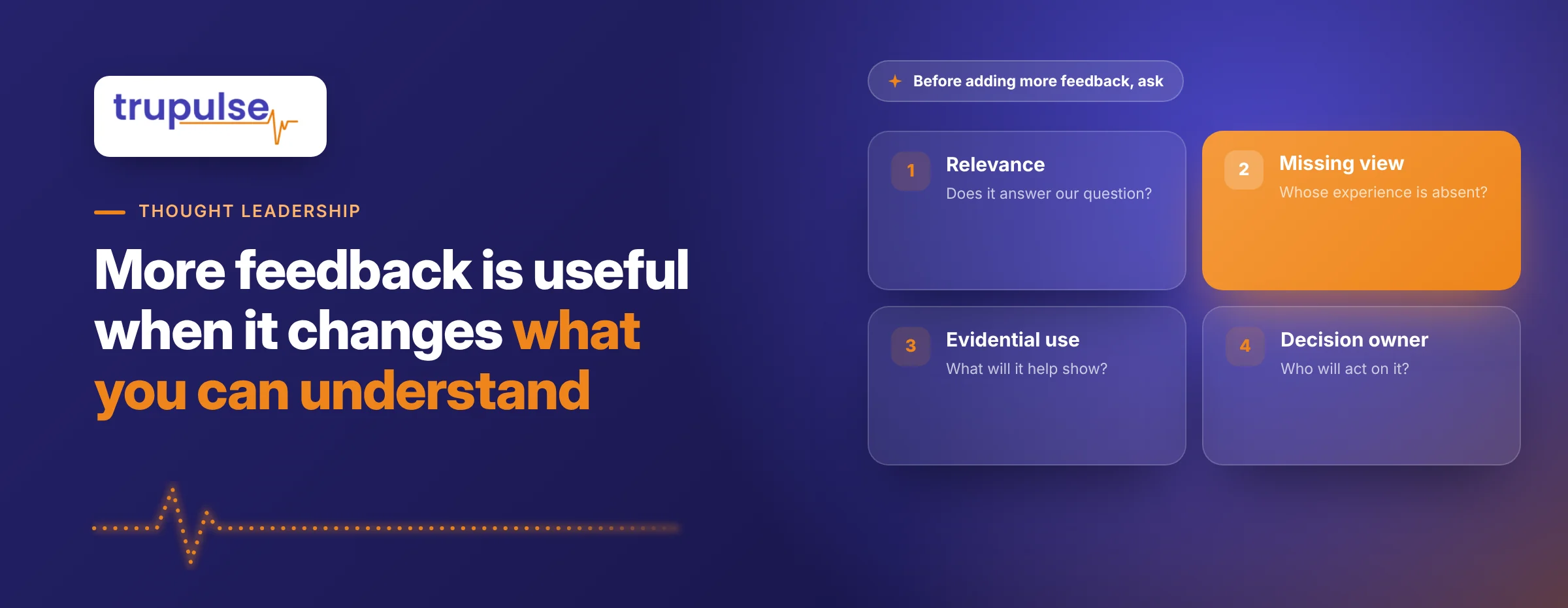
A response target can help manage a study, but it can't tell the team everything about the evidence it is getting. Start with relevance. Are people describing the experience your decision concerns? Then consider coverage. Could a meaningful experience remain outside the invitation route?
Next, consider what the material allows you to say. A detailed account might explain an obstacle worth investigating. It may not establish how common the obstacle is. If the team needs a population estimate, it needs a study designed to support that estimate, rather than a larger pile of convenient comments.
Finally, ask who will use the learning. Someone should be able to describe how different plausible findings would affect the next choice. In the support-hours example, one finding might favor exploring an evening option. Another might suggest clearer information about an existing support route.
This is a way of valuing feedback more carefully. Each participant has given attention to the organization. The team should have a reason to ask for more of it and a place for the answer to matter.
Sometimes more really is the right investment
There are good reasons to keep collecting. You may not yet have heard from an important group. You may need enough relevant observations for a planned analysis. You may have encountered conflicting explanations that deserve further exploration. Additional evidence can change the strength and usefulness of a conclusion.
The point is to connect that effort to the job. If your question concerns people who couldn't get through, improve the route to that experience. If your question requires a defensible comparison, design the collection and analysis around it. A broad claim that fewer responses are always sufficient would be just as unhelpful as treating more as automatically better.
Exploratory work also has value before a specific operational choice is ready. Hearing something unexpected can help an organization recognize a problem it hadn't thought to study. In that case, describe discovery as the purpose and create room to decide what deserves attention afterward.
Give the listening program a better success story
Instead of reporting only that participation increased, explain what became clearer. Perhaps the team distinguished a scheduling problem from a routing problem. Perhaps it discovered that an assumption didn't fit an important group. Perhaps it learned enough to stop pursuing a weak idea.
These outcomes may be less dramatic than a rising dashboard, but they give leaders a concrete account of why the listening mattered. Keep the participation picture alongside that account so the reader understands whom the findings describe.
AI can help organize and analyze the feedback available to it. Choosing which uncertainty deserves more attention remains part of directing the work. A faster route to another summary is valuable when it helps answer the question the organization actually faces.
At your next listening review, ask, “What can we understand now that we couldn't understand before?” Use the answer to decide where additional feedback would earn its place.